The Exceptional Summer Associate Playbook [SPECIAL EDITION]
An insider's perspective on the unwritten and unspoken rules of a BigLaw summer.

If you’re reading this, you’re likely about to walk into your first day as a BigLaw summer associate. You have a new badge, a new laptop, a stack of orientation paperwork, and a stomach full of nerves. Welcome (back)!
About me
I’m Nyssa, a privacy and data security attorney at Perkins Coie, a first-generation lawyer, and the author of Mentor in Law—this Substack and a monthly column in Colorado Lawyer magazine. I’m also Co-Chair of NAPABA’s Data Security and Privacy Committee and the Denver City Lead for the Leadership Council on Legal Diversity (LCLD). For three years, I served on Perkins Coie’s summer associate committee, which means I’ve spent three full summers on the other side of the table—recruiting, evaluating, mentoring, and watching what separates the summer associates who get offers from the ones who don’t. This is the playbook I wish someone had handed me, so I hope it helps you.
How to use this
I’ve written this in two parts, and both are important in equal measure. The first is strategic, covering the scaffolding underneath the summer associate program: how the offer decision actually gets made, what partners are tracking before you’ve done any real work, and the quiet dynamics that shape how you’re perceived from day one. Once you can see the frame, the rest of the program makes more sense. The second part is tactical, covering the day-to-day—how to take an assignment, how to ask for feedback, how to track partner preferences, and more. You can read it in order, or keep the second half nearby and pull it up when something specific comes up.
It's true that most BigLaw summer programs still have high offer rates, but the harder truth is that the small number of summer associates who don't get offers almost never lose them for legal skills. They lose them for professionalism, communication, judgment, or fit—the unspoken and unwritten rules of our profession. Those rules have always mattered, and they matter now more than ever. Summer classes are smaller than they were three years ago, callback-to-offer ratios have tightened, and the margin between a return offer and a quiet no-offer is thinner. This playbook aims to close the gap.
PART ONE: The Strategic Playbook
Below are five things to understand before you walk in. They are the unwritten rules of a BigLaw summer—the dynamics no one explains in orientation, the assumptions partners walk in with, and the patterns that, more often than not, separate the summer associates who get offers from the ones who don’t.
1. Your reputation starts now.
The offer decision at the end of the summer isn’t based only on one memo, one assignment, or one conversation. It’s based on ten weeks of small moments—the email you sent, the meeting you were late to, the partner you charmed at coffee, the assistant whose name you didn’t bother to learn. By the time the committee sits down to vote on offers, all of those moments have already been added up, and it’s your reputation that dictates whether you receive an offer or not.
This is what I mean when I say your reputation starts now. Every interaction this summer is a data point. The partner you had coffee with in week one will remember whether you were prepared. The associate who gave you a research assignment in week two will remember whether you turned it around on time. None of these moments will feel like much while you’re in them, and that’s the trap, because they’re exactly what people are going to remember.
So show up on time, respond to emails promptly, learn the names of all those around you, and be the version of yourself you’d want a partner to introduce to a client.
2. Your job this summer is to meet people and build relationships, not to master a practice area.
The substance of any practice area takes years to develop, and ten weeks isn’t enough time to become competent at much of anything. The summer associates who treat the program as a substantive proving ground—racing to master securities law or privacy or M&A in two months—almost always underperform compared to the ones who treat it as a relationship-building exercise. What you can do in ten weeks is start relationships that will compound across a thirty-year career.
The people you meet this summer will reappear in your professional life for decades, and not just the partners. The mid-levels, the senior associates, the fellow summers, and the lawyers down the hall in a practice area you may never join—all of them are part of the network you’re starting to build, whether you realize it or not. The substance of the law you can (and will) pick up later; the relationships are what start now. Partners and senior associates expect to hear from summer associates—it’s part of the program—so reach out and take advantage of that while you can.
A common mistake I’ve seen is treating firm events as optional or secondary to the work. They aren’t. The happy hour where six partners and three mid-levels will be in the same room is a working event, even if no one tells you that. The summer associates who treat it like one—showing up, being prepared, staying long enough to have real conversations—are the ones who end up with advocates at the offer vote.
3. This is your time to try everything.
It will never again be this easy to ask to be staffed on a matter in a practice area you’ve never seen, to request coffee with a partner whose work fascinates you, or to sit in on a client call that has nothing to do with your assignment. Use the access while you have it. If your firm allows cross-staffing, ask for it. If a senior associate three floors up has a niche that sounds interesting, reach out. If a pro bono case lands in a space you know nothing about, take it.
The summer is a research project on yourself as much as a tryout for the firm. By August, you should know more about what you like, what you don’t, and what you want to learn more about. That self-knowledge is one of the most valuable things the summer will hand you, and it is the thing summer associates most consistently fail to gather because they’re too focused on impressing one partner in one practice area to notice whether the work itself fits them. The short version: treat every assignment as a micro-experiment, and pay attention to which ones energize you and which ones drain you. That means saying yes to the things you think you’ll love and the things you think you’ll hate. What you learn about yourself is the point.
4. Treat everyone with respect, not just the people above you in the hierarchy.
This is an extension of the first rule about reputation, and it’s the one summer associates most often overlook. It’s tempting to focus all of your relationship-building energy upward, at the partners and senior associates and the people whose names appear on the matter team. Everyone else gets treated as background. The problem is that the firm doesn’t work that way. People talk constantly across the building, across functions, and across hierarchies. The legal assistant who supports the partner you want to work with sees every email you send. The paralegal on document review knows which juniors are easy to work with and which are condescending. The document services team, the conflicts team, and the docketing team all talk to each other, and the picture they form of you is often more accurate than the one the partners have. The way you treat the assistant who books your conference room is the way the partner they work for will assume you treat everyone.
The other reason this matters is that hierarchies aren’t fixed. The fellow summer associate you barely acknowledged at the welcome lunch becomes someone’s GC in fifteen years. The first-year you were sharp with on a Friday night becomes a hiring partner at the firm you’re trying to lateral into. The legal world is smaller than it looks, careers are longer than they feel, and the seating chart rearranges itself constantly. The way you treat the people who can’t do anything for you right now is the truest read on your professionalism—and any one of them could be your boss, your client, or your reference in a few years.
5. Use AI, but don’t let it replace the work that builds your judgment.
You’re entering the profession at a real inflection point. AI is going to be part of how lawyers work for the rest of your career, and most of you arrive more fluent in these tools than the partners you’ll be working with. The challenge isn’t whether to use AI—you should absolutely use it—but it’s how to use it in a way that doesn’t undercut the very learning that makes you a competent lawyer five years from now.
Start with the rules. Using AI well as a lawyer is a different skill from using it well as a student, and the firm’s rules about it are going to be tighter and more particular than anything you’ve encountered in law school. Most firms are converging on some version of a traffic-light policy: red for confidential client data in public tools, yellow for research and drafting that require partner oversight, green for low-risk administrative work. Ask about your firm’s specific version on day one.
The rules tell you what you’re allowed to do. The harder question is what you should do, even when the rules say you can. This is where most summer associates get into trouble: AI can do a surprising amount of the work that used to be how junior lawyers learned the job. The drudgery of reading the deposition transcript yourself, pulling the cases yourself, writing the first draft of the memo yourself—that work is how you actually learn to practice law. More specifically, that work is how you build judgment, which is the ability to know what matters in a document, a record, or a set of facts, and what doesn’t. Judgment comes from the friction of doing the underlying work and getting it wrong enough times to know what right feels like. AI removes the friction, and it also removes the learning. Outsource the work to a tool before you’ve done it enough times to know what good looks like, and you’ll end up with the credentials of a senior lawyer and the judgment of a first-year. So use AI for what it’s good at, but not as a shortcut around the parts of the work that are teaching you how to be a lawyer. Judgment is the one thing AI can't replicate (at least not yet), and it's the reason you'll likely still have a job in ten years.
A few practical notes are worth keeping in mind. Never paste confidential client information into a public AI tool, even to test what it can do. Verify everything an AI tool produces against the underlying source—every case, every fact, every quotation. Check your work before you turn anything in, every time. A hallucinated citation or a wrong fact that traces back to AI will follow you longer than the assignment itself, and your reputation is the thing you’re building this summer. And if you use AI to accelerate part of an assignment, be transparent about it.
Those are the unwritten rules that shape whether you get an offer. Part Two is the tactical playbook—the templates, scripts, and systems you’ll actually use day to day.
PART TWO: The Tactical Playbook
Most of what makes a summer associate strong isn’t talent or legal skill—it’s the operational practices and tools nobody teaches in law school: project management, attention to detail, and organizational systems that hold up when the volume picks up. The job requires tracking multiple assignments without dropping one, managing up to several partners at once with their own preferences and quirks, hitting deadlines without being reminded, and keeping your work product clean enough that a senior associate can pick it up without rewriting it. None of that comes naturally to most people, but all of it can be built and learned if you set up the right systems early. The next several sections cover those systems—what to track, how to track it, and the small practices that compound across the summer.
The personal user manual
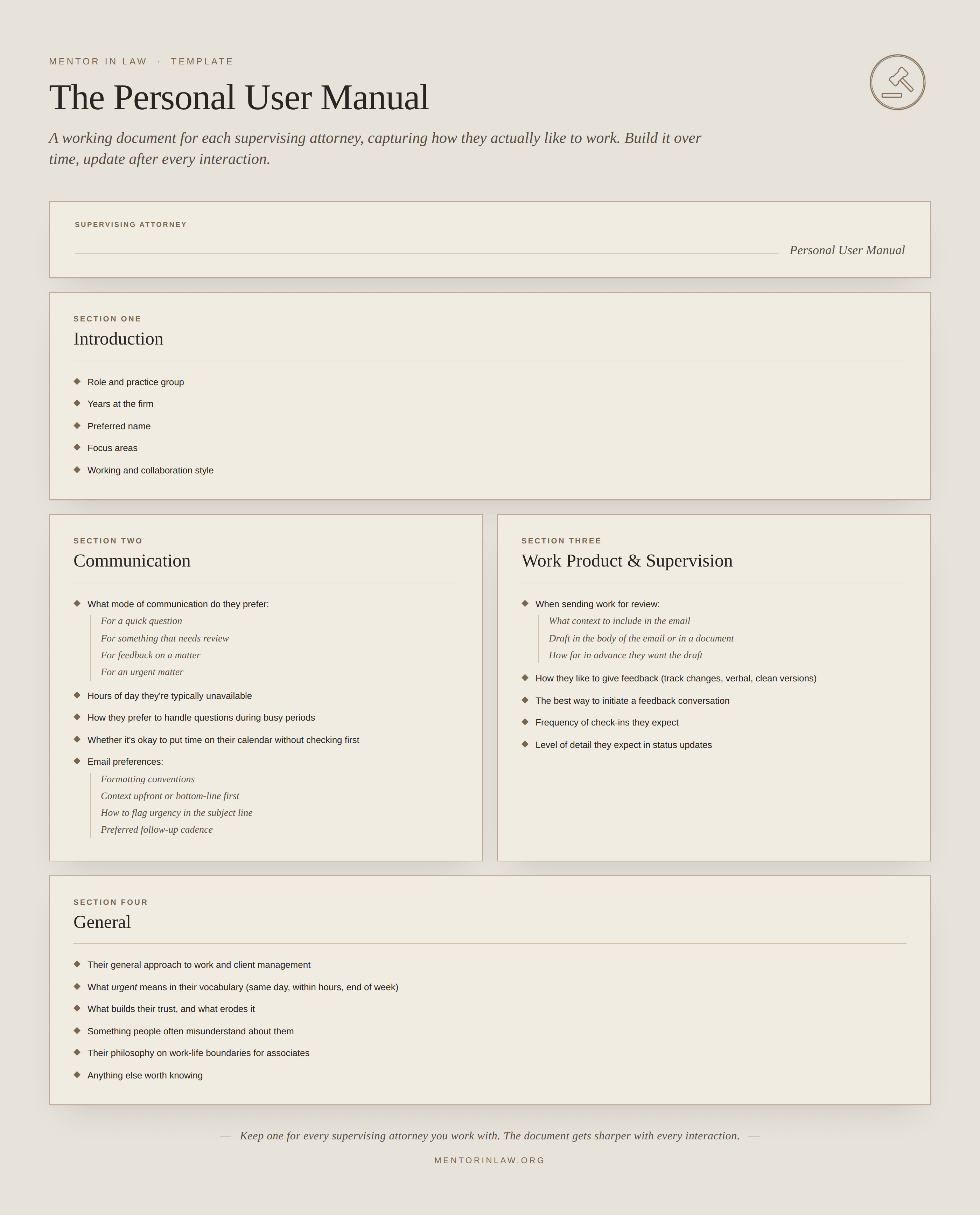
If I had to pick one practice for a summer associate to start on day one, it would be to create a personal user manual for every supervising attorney you work with. The manual is a short working document—anywhere from a paragraph to a page—that captures how each attorney actually works: how they like drafts, what urgent means in their vocabulary, how they prefer to be reached, and the feedback patterns that show up in their edits. You won't get the answers right at the start, and that's the point. You build the document over time, updating it after every interaction, and by the end of the summer you have a working playbook for each supervising attorney you've worked with. I wrote about the personal user manual in depth in my August 2025 column, including a template on what to track.

The summer associate assignment tracker
By week three, you’ll be staffed on more assignments than you expected, from more partners than you expected, and the summer associates who are doing well are the ones who can tell any partner where their matter stands without checking their notes. That kind of command isn’t a personality trait—it’s a system. The simplest version is a one-page tracker you update at the end of every day, and the discipline of looking at it before you leave the office will catch the dropped ball before the partner does. Below is the format I recommend, adapted from what I keep for my own matters.
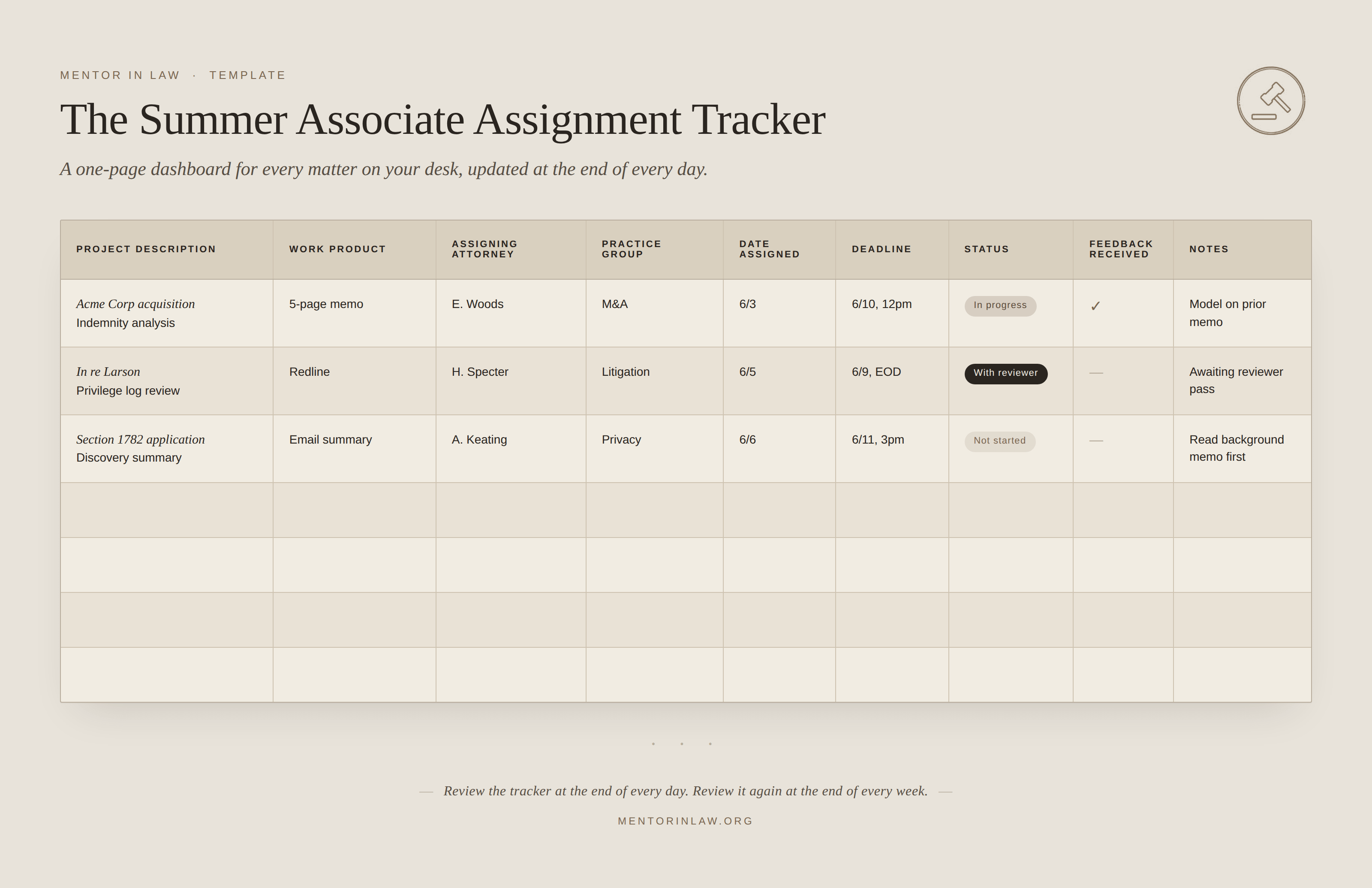
Review the tracker at the end of every day, and again at the end of every week. The end-of-day review catches what’s slipping and what’s coming up. The end-of-week review shows you the pattern—which practice groups you’re getting pulled into, which partners are sending you the most work, and what kinds of assignments you’re doing.
Questions to ask for every assignment
Most summer associates leave the assignment conversation too early. They nod, take the file, and head back to their office before they look unprepared. That’s the most expensive mistake you can make. As a summer, you’re not expected to know the law—you’re expected to ask enough questions to figure out what you don’t know before you start. Five minutes of clarifying questions up front will save you five hours of misdirected work later, and it will save the reviewing attorney from rewriting half your draft because you were guessing at things you could have asked about.
Below are the questions worth asking, or at least answering for yourself, every time a new assignment lands.
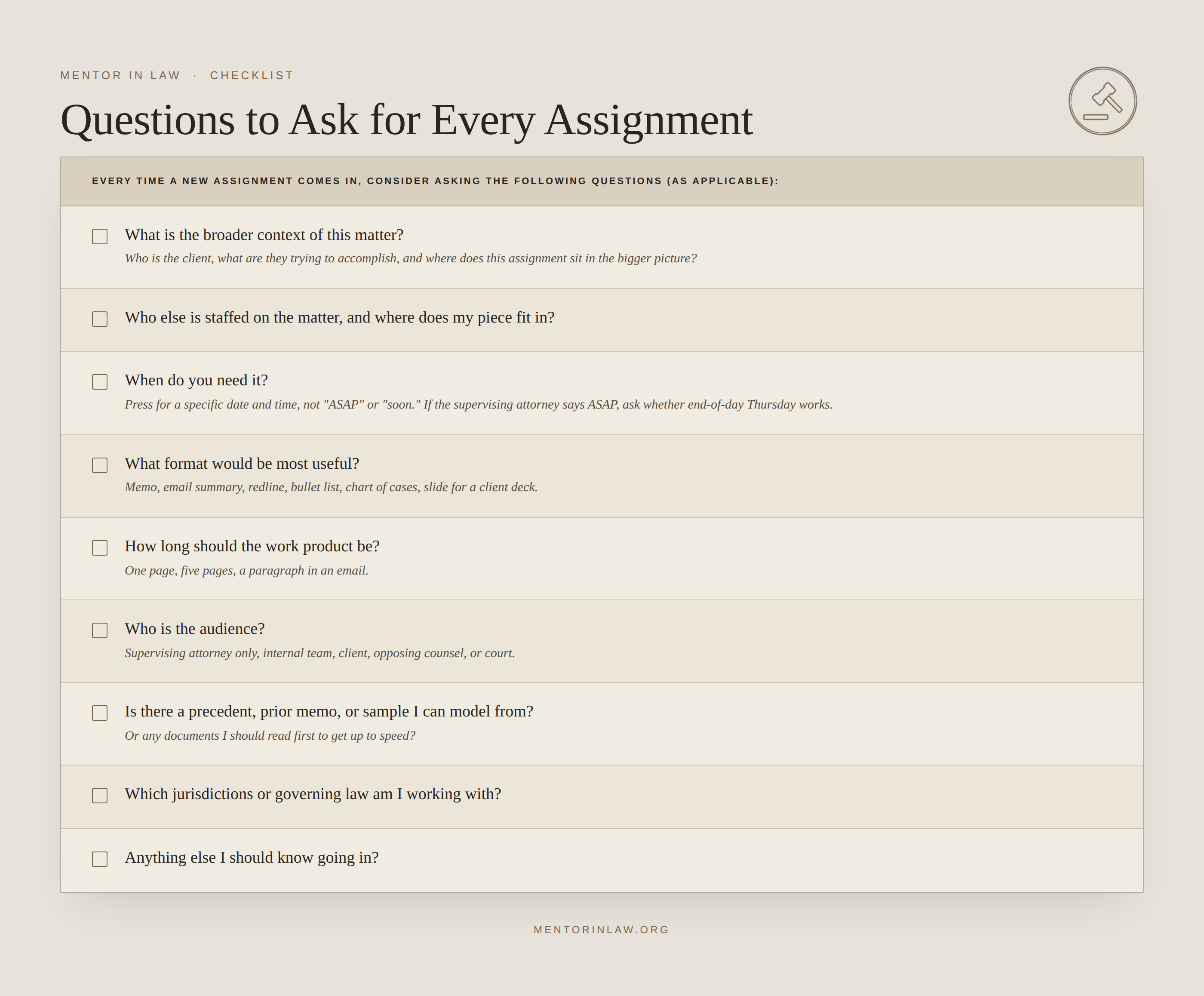
Two follow-up habits make this work. First, before you leave the conversation, read back the assignment in your own words. A short "let me make sure I have this right—you'd like a five-page memo by Thursday at noon analyzing whether X is enforceable under Colorado law, modeled on the format of the Smith memo from last year" gives the supervising attorney one easy chance to correct you. Second, send a written confirmation by email within an hour. It doesn't have to be long—just a short email about what you understood the assignment to be, the deadline, and the format. That email is your protection if anything later goes sideways.
The same instinct applies on the tail end of the assignment, when it's time to turn the work in. When a supervising attorney asks for a draft, they rarely mean a working draft. They mean a polished version they can review and edit, not one they have to completely rewrite. Build proofreading into your timeline. Read the document out loud before you hit send. Check every citation against the source. A reader who notices typos and formatting errors starts looking for substantive ones, and that's a hole that's hard to climb out of. The polish is part of the work, not separate from it.
The art of email
Every email you send is a small sample of how you think, how you write, and how seriously you take the work, and partners are reading those samples. There is an art to drafting emails. I wrote about that and best practices you can follow in my January 2026 column below.

Asking for feedback
BigLaw has a (silent) feedback problem. Supervising attorneys are busy, and when they’re not happy with a piece of work, the path of least resistance is often to fix it themselves and move on, rather than walk you through what they would have done differently. That means you can’t wait for feedback to come to you. If you want to know how you’re doing, you have to ask.
Consider these rules before asking. Be specific. Don’t ask “any feedback?” because that question almost always gets you “looks great.” Ask after a particular assignment, with a particular question—what worked, what didn’t, what you’d want me to do differently next time. Be patient. Supervising attorneys often have more useful things to say when they have a minute to think than when you catch them between meetings, so consider asking in writing. And come back to the same supervising attorney more than once, so you can see whether the feedback from the first assignment actually showed up in the second.
Below are three short scripts worth using at three different points in the summer.
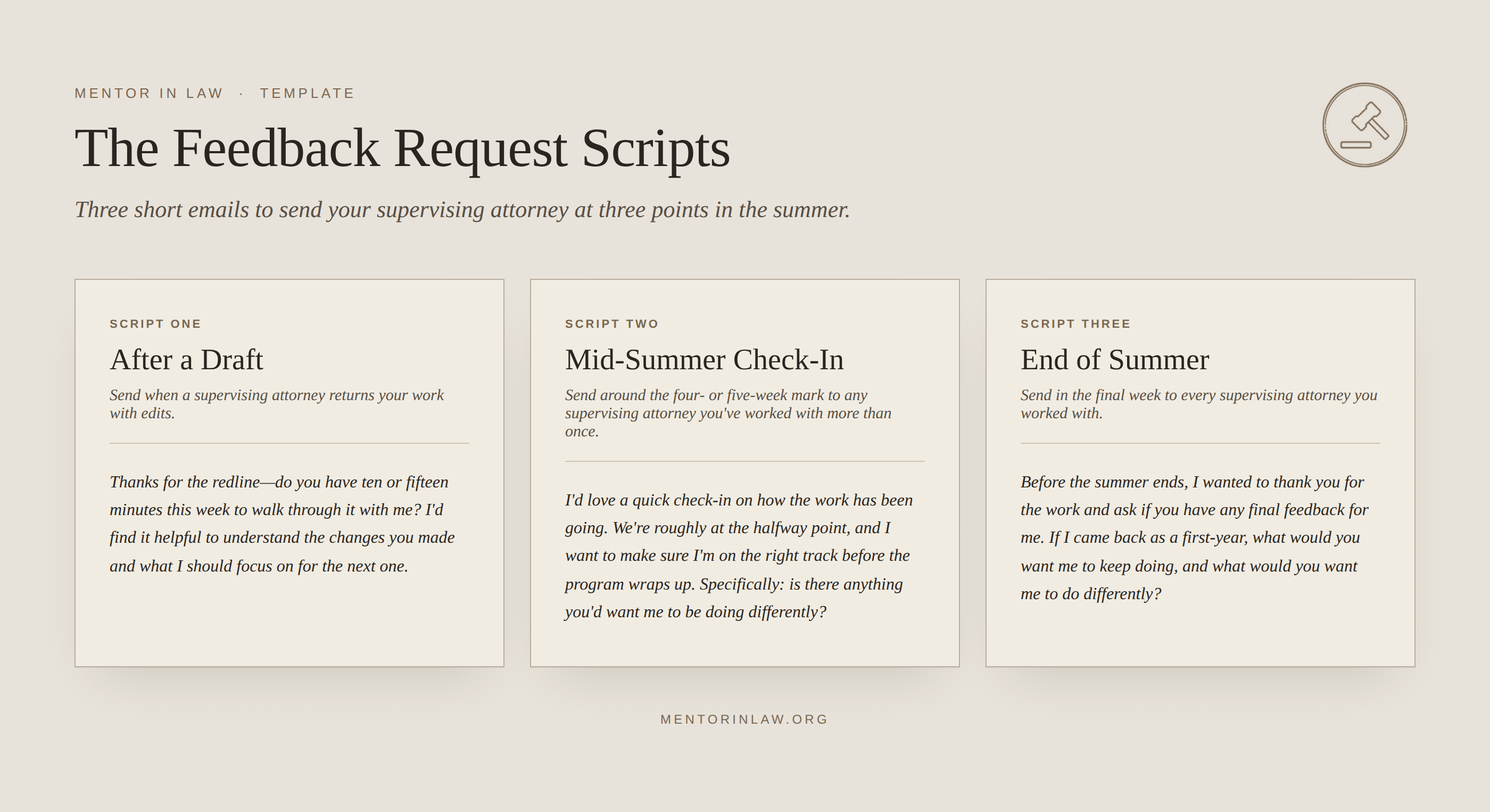
When you do get critical feedback, take it in stride. It’s information, not a verdict. The summer associates who handle it well are the ones who acknowledge it, ask one clarifying question if needed, and then show the change in the next piece of work.
The wins log
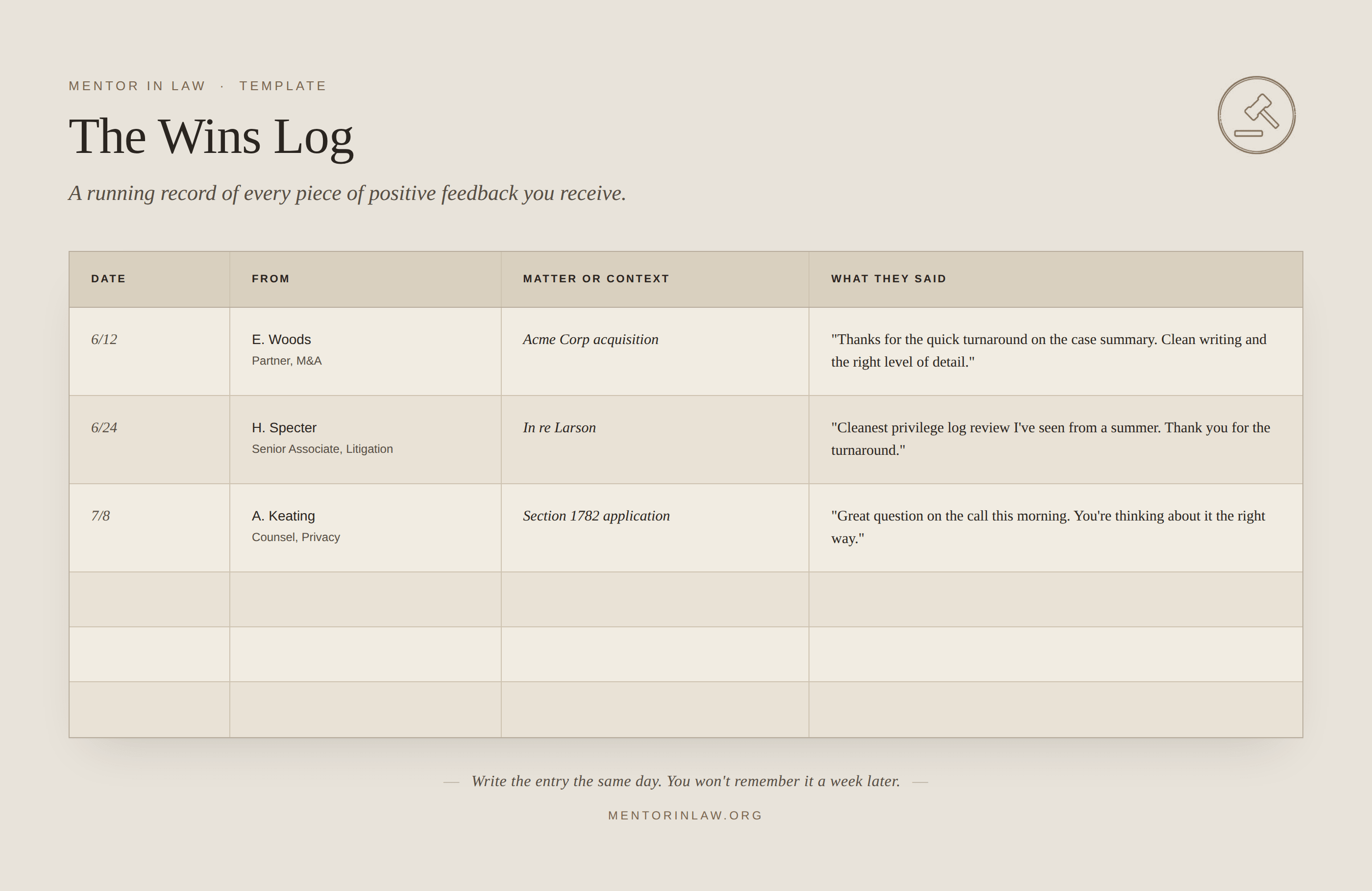
Negativity bias is real. The brain weighs criticism more heavily than praise, and the criticism sticks longer. For summer associates, that means the one redline from a partner will outweigh five compliments by the end of the week, and by the end of the summer the positive moments are almost impossible to recall. The wins log is the corrective. It’s a running record of every piece of positive feedback you receive, written down in real time so you can actually use it later.
It pays off in three places: 1) your end-of-summer self-evaluation, when the firm asks you to describe your contributions; 2) the memo your supervising attorney drafts for the offer committee, where specific examples from real supervisors carry far more weight than general claims; and 3) the harder days when the critical feedback is drowning out everything else and you’re questioning your decision to become a lawyer. Write the entry the same day, in the exact wording you heard.
One last note
Ten weeks goes faster than you think. You’ll spend the first two weeks figuring out where the printer is, the next four weeks doing the most interesting work you’ve done in years, and the last four weeks wondering where the time went. Somewhere in the middle, you’ll meet a partner you genuinely want to learn from. Somewhere in the middle, you’ll write a memo you’re proud of. Somewhere in the middle, you’ll have a conversation at a firm dinner that you’ll still remember in a decade.
The summer associates who get the most out of the program are the ones who treat it as a chance to learn rather than a ten-week audition. Stay curious about the work, generous with the people around you, and honest with yourself about what you're actually learning. Show up on time, ask good questions, take notes, and trust that the rest will follow. It usually does.
👉🏼 If you found this useful, share it with another summer associate who’s about to start. Mentor in Law was built for the first-generation lawyers walking into their first summer without knowing the unwritten and unspoken rules of the legal profession. Good luck this summer—I hope it’s the start of something great.